Fracht Group Australia Logistics News - January / February 2026
20/1/2026
"The secret of change is to focus all of your energy, not on fighting the old, but on building the new."
- Dan Millman
AROUND THE WORLD
- SUEZ CANAL TRANSITS ARE SLOWLY RECOVERING but remain 60% below pre crisis levels, as carriers continue to avoid the region despite months without attacks. Drewry reports 26 container vessels transited in the second week of January—an increase from 10 the week before, but far below the usual 80 weekly transits. The majority of traffic now consists of backhaul vessels, reversing traditional patterns and highlighting continued reluctance among major carriers. While CMA CGM and MSC have sent limited large vessels through, most operators remain cautious. Analysts warn that the timing and scale of a full Suez return will significantly impact global capacity, rates and transit times throughout 2026.
- EUROPE’S PORTS PREPARE FOR ‘THE INEVITABLE’ VOLATILITY when carriers resume full Suez Canal routings. With services currently stabilised via the Cape of Good Hope, Flexport warns that the return to Suez will disrupt vessel schedules, causing bunching and sharp spikes in cargo arrivals. This is expected to trigger congestion, reduced crane productivity, fuller warehouses, and a potential shortage of empty containers in Asia, similar to the imbalance seen after the Ever Given incident. Antwerp-Bruges, Hamburg and Rotterdam say they are strengthening digital tools, ETA systems and night logistics to manage the shift, but all acknowledge that simultaneous Cape- and Suez-route arrivals will temporarily strain capacity.
- MAERSK HAS WAIVED ITS RED SEA “transit disruption fee” after the Maersk Sebarok successfully transited the Suez Canal—its first such passage after months of diversions via the Cape. The move suggests Maersk is cautiously exploring a phased return, but the next vessels on the same rotation continued around Africa, underscoring ongoing security concerns. Maersk says it will pursue a “stepwise approach” to reinstating Suez transits, with no immediate network-wide changes. The carrier emphasises that broader east-west Suez routing will depend on stable and verified Red Sea security conditions.
- DELAYS AND CONGESTION AS EUROPEAN PORT OPERATIONS FEEL THE COLD. Winter weather is disrupting operations across Northern and Western Europe, with delays from snow, ice and road closures reported. Hamburg terminals faced partial shutdowns, while Rotterdam’s ECT Delta halted all operations, advising drivers to avoid the terminal. Antwerp remains largely unaffected. With harsh conditions expected to continue, forwarders warn of rising congestion, missed cut-offs and slow recovery across major North Range ports.
- HEAVY SNOWFALL FORCED SCHIPHOL AIRPORT TO HALT freighter operations after running out of de-icing fluid, giving priority to passenger flights. More than 2,000 flights were cancelled, and KLM imported 100,000 litres of de-icer from Germany. A temporary embargo on freighter de-icing remains in effect, prompting KLM Cargo to restrict free-sale capacity, suspend special-product shipments and warn of delays to Martinair schedules. Many airlines diverted or cancelled flights entirely. Industry group ACN criticised Schiphol’s lack of preparedness, noting similar failures occurred in 2021 despite warnings about extreme winter conditions. While operations are expected to normalise soon, significant backlogs will take time to clear.
- ONE AND HAPAG-LLOYD THE LATEST CARRIERS TO INVEST IN BOX TERMINALS, with ONE acquiring a minority stake in Dalian Container Terminal and Hapag-Lloyd purchasing 50% of the new deepwater terminal in Aracruz, Brazil. Dalian, handling 6.6m TEU (twenty foot equivalent units) annually, strengthens ONE’s access to Northeast China and supports ongoing green and infrastructure development. In Brazil, the Aracruz terminal—opening in 2028 with 1.2m TEU capacity—will enhance Hapag-Lloyd’s presence in Brazil’s growing cabotage and international trades, providing a new hub closer to key markets.
SEAFREIGHT NEWS
- MSC AND CMA CGM SERVICE REVISIONS GO HEAD-TO-HEAD ON THE TRANSATLANTIC. MSC has overhauled its Canada Express service, adding multiple Spanish port calls and effectively replacing the former NWC Spain / Portugal loop. To maintain weekly frequency, MSC has deployed a sixth vessel, though average ship size will drop from 3,300 TEU to 2,800 TEU. Meanwhile, CMA CGM has expanded its Amerigo service to include Halifax, deploying 6,800–7,300 TEU ships—around 50% larger than existing transatlantic vessels at the port. Halifax will see its highest monthly pro-forma capacity since 2023, intensifying competition between the two carriers.
- CONGESTION AT MAJOR EUROPEAN PORTS, especially Rotterdam, is prompting ONE, HMM and Yang Ming to consider removing Rotterdam from one or more Asia–Europe loops. Shippers report severe delays and poor on-time performance, with carriers exploring a Gemini-style hub-and-spoke model to improve reliability. Analysts note that ultra-large container vessels are intensifying congestion by discharging up to 5,000 containers per call, overwhelming terminals when multiple megaships arrive close together. Carriers are under pressure to provide clarity ahead of contract renewals. ONE has begun adjusting other trades, adding a new direct Vietnam call on its transpacific services to improve connectivity.
- CONTAINER TRADE STATISTICS DATA shows global liftings rose 2.8% month-on-month in October to 16.3m TEU, with year-to-date volumes up 4%. However, Sea-Intelligence reports an “abrupt slowdown” in TEU-mile growth—just 0.1% in October. The key driver is a sudden decline in Asia–Europe momentum, where imports swung negative after months of strong growth. Because cargo is still rerouted via the Cape, the downturn has an outsized effect on global TEU-miles. A full return to Suez routings in 2026 could trigger a 16.8% drop in TEU-mile demand. Sub-Saharan Africa remains a bright spot, with imports up 16% year-to-date.
- WALLENIUS WILHELMSEN has secured two major contract extensions worth nearly USD 500 million combined, reaffirming long-term partnerships with leading European automotive and heavy-equipment manufacturers. One contract, extended to 2030, carries USD 384 million in new value and includes added volumes and trade lanes, along with a multi-fuel BAF aligned with 2040 net-zero goals. A second contract, extended to 2028, adds USD 114 million in value and similarly incorporates emissions-aligned surcharge mechanisms. Both customers aim to deepen supply chain integration, with Wallenius Wilhelmsen emphasising its commitment to zero-emission shipping technologies and end-to-end logistics solutions.
- MSC WIDENED ITS LEAD as the world’s largest carrier in 2025 by adding 831,400 TEU - representing 39% of all capacity added by the top 12 carriers. The expansion, driven by 54 newbuildings plus second-hand acquisitions, pushes MSC’s total fleet growth to 11.7%. With an orderbook of 114 ships exceeding 2m TEU, analysts say MSC’s dominance is secure for years. By contrast, Maersk’s fleet grew just 4.3% (17 newbuildings), while CMA CGM increased capacity 7.5% to 4.13m TEU - still short of Maersk’s 4.61m TEU. HMM posted the fastest percentage growth at 12.8%, while ZIM saw capacity fall due to returning expensive chartered tonnage.
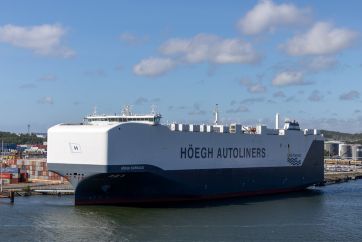
- HOEGH AUTOLINERS HAS TAKEN DELIVERY of the final LNG-powered vessel in its first batch of eight 9,100-CEU (Car Equivalent Units) Aurora-class PCTCs (Pure Car and Truck Carrier). The Höegh Rainbow follows seven sister ships and precedes four upcoming ammonia-ready units due in 2027, which the company says will achieve near-zero CO2 emissions. Both developments underscore intensifying investment in cleaner, larger, next-generation automotive carriers across the Scandinavian PCTC segment.
- BLANK SAILINGS PICK UP AS LUNAR NEW YEAR APPROACHES. Carriers on the China–Australia trade are increasing blank sailings ahead of Lunar New Year as demand projections soften. The Triple A consortium will blank both A3C and A3S Week 9 voyages, while CAT and NAX / NEAX are blanking multiple weeks. MSC is implementing several blankings across Panda / ZAX, Wallaby, Koala and Kangaroo services due to vessel redeployments, including shifts to its new Eagle ANZ–ECNA service. Maersk / ONE’s Dragon service remains unaffected, though weather-related port bypasses have occurred in New Zealand.
AIRFREIGHT NEWS
- AIR CARGO HAS A RECORD OCTOBER WITH 4.1% DEMAND GROWTH. IATA reported the strongest October on record, with global air cargo demand rising 4.1% year-on-year — the eighth consecutive month of growth. Capacity increased 5.1%, though load factors dipped slightly. While Asia–North America volumes fell 1.4% due to US tariff impacts, other regions showed strong momentum: Europe–Asia was up 11.7%, within-Asia 9%, and Middle East–Asia 11.5%. African carriers led global growth at 16.6%. IATA said the figures reflect shifting trade patterns as supply chains adapt to tariff uncertainty, with air cargo playing a critical role entering peak season.
- AIR CARGO INDUSTRY EXPECTS TARIFF VOLATILITY but milder levies than threatened. Analysts expect continued volatility in 2026 as tariffs, e-commerce and Southeast Asia export strength shape market dynamics. Xeneta’s Niall van de Wouw said actual tariff increases in 2025 were far lower than threats — around 12% versus the 30–100% levels signalled — helping prevent a collapse in US inbound demand. Flexport forecasts low single-digit demand growth in 2026, with slightly higher capacity pressuring rates, though still above pre-pandemic levels. A strong second half is anticipated, driven by Asia-origin e-commerce and AI-related hardware.
- GLOBAL AIR CARGO VOLUMES rose 5% year-on-year in November, providing a welcome lift ahead of the holiday season. Xeneta says demand was surprisingly strong in September and October, aided by freighter redeployment from the transpacific to Asia–Europe, which helped balance yields. However, Southeast Asia spot rates to North America and Europe saw double-digit declines. Analysts warn 2026 may bring further challenges as shippers eventually pass higher costs to consumers. While this is not a traditional peak season, it is busier than expected, though e-commerce-driven growth shows signs of slowing after two strong years.
- CATHAY PACIFIC CARGO REPORTS SOLID OCTOBER WITH 6.4% GROWTH. Cathay’s new cargo director Dominic Perret reported a stronger-than-expected peak season, despite e-commerce pressures from the end of the US de minimis exemption. October tonnage rose 6.4% year-on-year, though load factors slipped to 60.3%. The airline has been shifting capacity across its global network to capture emerging opportunities and has added Madrid as a European freighter stop, where loads are reported as “almost full.” The carrier is also using Europe as a transit hub for South American perishables—particularly salmon and fruit—into Asia.
- KENYA AIRWAYS IS MOVING AHEAD with its cargo-first strategy, aiming to double cargo’s share of group revenue from 10% to 20% in 2026. The airline will add two Boeing 767 freighters within months, ahead of plans to operate three Boeing 777Fs by 2030. Widebody aircraft are expected to strengthen its Asia Pacific connectivity, with Guangzhou and Hong Kong identified as targets. Initial 767 operations may include Middle East technical stops to support perishables, returning with e-commerce cargo. Alongside fleet expansion, Kenya Airways Cargo is investing in digital tools for real-time tracking and yield optimisation, while expanding partnerships with carriers including Qatar Airways, Saudia, Ethiopian Airlines and China Southern.
- EMIRATES SKYCARGO PLANS a major fleet expansion in 2026, targeting the addition of 10 Boeing 777 freighters and increasing its 777F fleet from 11 to at least 21 units. The airline has outstanding orders for 10 new-build 777Fs and 10 passenger-to-freighter conversions with Israel Aerospace Industries. Emirates says the increased capacity will unlock new network opportunities and enhance schedule reliability. In 2025, SkyCargo launched services to eight new destinations and increased frequencies on high-demand routes like Guangzhou and Johannesburg. Digital transformation continues, with nearly 80% of bookings now digital and PayCargo implemented for instant payments. Its pharma, perishables and express products all saw double-digit growth.
- MUMBAI AIRPORT PLANS 10-MONTH FREIGHTER SUSPENSION for major upgrade.Mumbai’s Chhatrapati Shivaji Maharaj International Airport will suspend all freighter operations from August 2026 to May 2027 to rebuild its deteriorated cargo apron and recarpet the main runway. Operator MIAL said relocating freighters elsewhere on-site is impossible due to space and continuous passenger operations. The airport, constrained by its single-runway design, handles more than 850,000 tonnes annually. Cargo groups warn the move could harm India’s exports—already pressured by US tariffs—and increase logistics costs.
- HONG KONG AIR CARGO UP 3.6% in December on transhipment growth, reaching 462,000 tonnes, driven by strong export and transshipment flows—including an 18% surge in transshipments. Full-year 2025 cargo throughput grew 2.7% to 5.1m tonnes. HKIA’s operator highlighted the airport’s strengthened global connectivity, including 30 new destinations and higher frequencies on major routes. Recent investments such as the Three-Runway System are helping accommodate more airlines and cargo flows. Hactl and Flexport expanded cooperation to cement Hong Kong’s role as a regional transit hub, while the Air-Land Fresh Lane continues improving cross-border perishables handling into the Greater Bay Area.
OCEANIA PORTS AND AIRPORTS
- PORT OF MELBOURNE RELEASED ITS 2025 SUSTAINABILITY REPORT, highlighting long-term commitments across People, Planet, Partnerships and Prosperity. CEO Saul Cannon said the port aims to deepen collaboration with government, industry and community to drive broader impact. Highlights include: 61% renewable electricity use, a 62% reduction in Scope 1 & 2 emissions since FY22, and engagement with stakeholders representing 78% of Scope 3 emissions. PoM supported over 18,000 seafarers via Mission to Seafarers Victoria and Stella Maris, funding improved access and expanded community programs. The port handled a record AUD154 billion in trade and 3.39 million TEU, with 96% of suppliers locally based.
- QUBE OPENS NEW SYDNEY REEFER TERMINAL as it unveiled the first stage of its new 220-slot reefer terminal at the Moorebank Intermodal Terminal, expanding the IMEX precinct’s cold-chain capacity. Qube Logistics NSW general manager Jack Moore called the opening a major milestone in improving efficiency and connectivity for importers and exporters. The facility offers energy-efficient refrigerated storage with streamlined links to inland rail and Port Botany via a dedicated freight line.
- INDUSTRY GROUPS HAVE CRITICISED the findings of the ACCC's Container Stevedoring Monitoring Report, saying landside operators are absorbing the cost of stevedore profit growth. The report noted quayside lift revenue fell 0.4% in 2024/25, while landside and other revenue per lift surged 12.2%. Stevedore operating profits hit AUD808.6 million—up 130.5% in five years—despite stable costs and minimal productivity gains. CTAA’s Neil Chambers and APSA / FTA representatives said the data confirms stevedores are increasing prices in a low-efficiency environment. Stevedores did not comment, though Patrick Terminals reiterated its focus on investment and service enhancements.
- GEELONGPORT HAS ACHIEVED its fifth consecutive global Number 1 ranking in the GRESB (Global Real Estate Sustainability Benchmark) Infrastructure Asset benchmark, earning a five-star rating for sustainability. Its 2025 report highlights major initiatives including recycled-asphalt port roads, a 91% emissions reduction in Scope 1 & 2 since 2018, and continued contribution to Victoria’s clean-energy transition through the Golden Plains Wind Farm Program. Stage 1 of the project prevents 770,000+ tonnes of annual emissions and Stage 2 is underway. The port also formalised its partnership with the Wadawurrung Traditional Owners and was recognised among Work180’s Top 101 Workplaces for Women.
- EXTRA MONEY FOR WA’S WESTPORT, KWINANA. Western Australia has directed more than AUD50 million in additional funding to support Westport and the Kwinana Industrial Area through its 2025–26 Mid-Year Review. This includes AUD30million for early works such as land acquisition, design refinement and environmental impact minimisation, plus AUD22.5 million for planning the replacement of the ageing Kwinana Bulk Terminal. The new terminal will be relocated southward to enable the future container port footprint. Ministers Rita Safioti and Stephen Dawson said the investment will de-risk delivery, support decarbonisation and long-term growth, and address future bulk and container capacity needs within the Western Trade Coast.
- PORT DARWIN’S LATEST ANNUAL REPORT CARD shows significant gains in trade, sustainability and community outcomes. Vessel visits increased 31% to 2,295 in 2025, with total throughput rising 23.5% to 1.93 million tonnes. Cruise ship calls also grew 9.35% to 117. The port installed 99 new solar PV systems and began formal emissions accounting ahead of its 2040 emissions-reporting target, with an 80% reduction goal and net-zero by 2050. Community initiatives included new harassment-prevention policies, mental-health training, zero pest incursions and AUD316,200 in sponsorships. Employee engagement reached 74%, reinforcing the port’s focus on ESG leadership.
- TASPORTS AWARDED CONTRACT for the major rebuild of Hobart’s Macquarie Wharf 6 to the Hazell Bros–Brady Marine & Civil joint venture. The project is part of a multi-stage redevelopment supporting the Australian Antarctic Division and RSV Nuyina operations. Works include full wharf demolition and reconstruction, shore-power installation, and significant infrastructure upgrades. Ministers Murray Watt and Jeremy Rockliff emphasised the project’s economic, scientific and strategic importance, backed by an AUD188 million federal commitment. Mobilisation will begin early next year, with completion due before August 2028. Wharves 4 and 5 will follow, expanding Tasmania’s export and cruise capacity.
CUSTOMER SERVICE
If you would like further information about any of the above items, please contact one of our friendly Fracht Team members at fracht@frachtsyd.com.au
Share this news via